
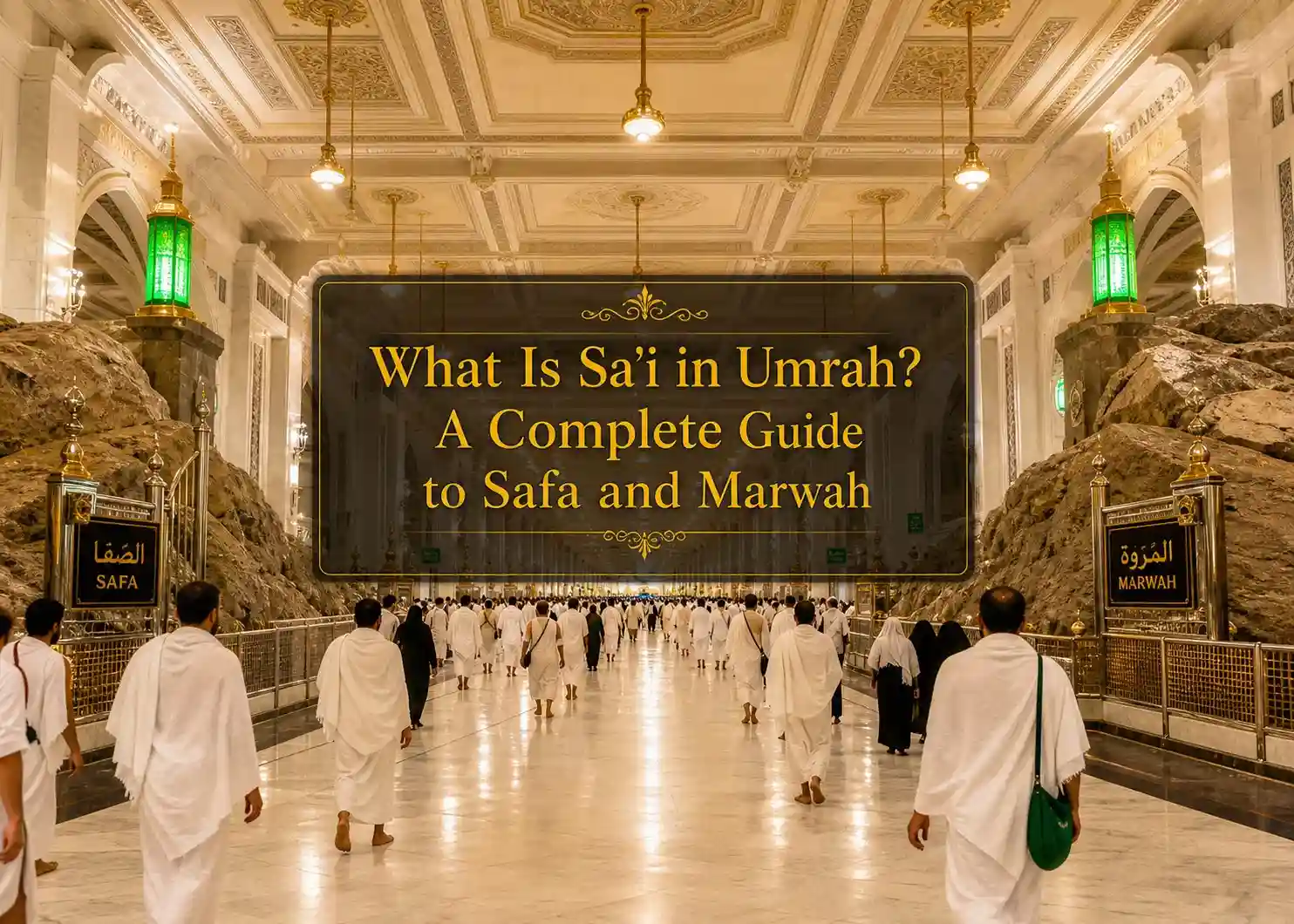
Sa’i in Umrah is the ritual of walking seven times between two small hills, Safa and Marwah, and for most pilgrims it’s the part of the journey that hits hardest emotionally. Where Tawaf feels steady and meditative, Sa’i feels urgent. You will be retracing the footsteps of a mother who ran between these same two hills, alone, searching for water for her dying son.
If this will be your first Umrah, you’ve probably got questions about it. Where exactly do you walk? What do you say? Is there a wrong way to do it? This guide covers all of that: what Sa’i means, where Safa and Marwah are, the story that gave the ritual its meaning, how to walk it step by step, and the duas pilgrims recite along the way.
What Is Sa’i in Umrah?
Sa’i in Umrah means walking between Safa and Marwah seven times, immediately after Tawaf around the Kaaba. It isn’t an optional add-on. Scholars classify it as a pillar of Umrah, so without it, the pilgrimage simply isn’t complete.
The word itself comes from the Arabic root “sa’a,” meaning to strive, to hurry, to pursue something with real effort that’s not a coincidence. You are, quite literally, walking out a story of striving.
Tawaf and Sa’i sit next to each other in the sequence of Umrah, but they feel almost opposite. Tawaf circles calmly around one fixed point. Sa’i moves in a straight line, back and forth, with a kind of restlessness built into it, because that’s exactly how it happened the first time.
If you have not yet read our full guide on how to perform Umrah step-by-step, it explains where Sa’i fits within the wider journey, from Ihram to the final hair trimming.
Where Are Safa and Marwah Located?
Safa and Marwah are two small hills inside the Masjid al-Haram in Makkah. Safa sits close to the Kaaba, while Marwah stands a short distance away. Today, both hills sit within a long, covered walkway inside the mosque itself.
You do not need to step outside the mosque to perform Sa’i. The whole path is air-conditioned, wide, and clearly marked. There are separate lanes for people who walk and for those who use wheelchairs. This way, elderly pilgrims and people with health needs can complete Sa’i in Umrah with ease.
The distance between Safa and Marwah is around 450 metres. One full circuit means walking from Safa to Marwah, or Marwah to Safa. Every pilgrim walks between Safa and Marwah seven times in total, which adds up to roughly 3.15 kilometres.
The Story Behind Safa and Marwah
To understand Sa’i in Umrah, you need to know the story that gave it life. This story goes back thousands of years to Prophet Ibrahim (AS), his wife Sarah (AS), her servant Hajar (AS) and Hajar’s infant son Prophet Ismail (AS).
Sarah (AS) struggled with infertility for years, so she graciously suggested that Ibrahim (AS) marry her servant, Hajar (AS), in hopes he could finally have a child. From their union came Ismail (AS), who would eventually become the lineage forefather of the Arabs.
Hajar (AS)’s Unwavering Trust in Allah
Allah instructed Ibrahim (AS) to take Hajar (AS) and baby Ismail (AS) to the empty valley of Makkah soon after the birth. He left them there with only a small bag of dates and a container of water. There was no shelter, no other people and no clear water source nearby.
Hajar (AS) asked him a simple question: “Did Allah command you to do this?” When Ibrahim (AS) said yes, then she replied with full trust: “Then Allah will not let us be lost.” This single sentence shows her trust in Allah.
Hajar (AS)’s Search for Water
The baby Ismail (AS) grew thirsty over days. Hajar (AS) became desperate to find water. She ran between the two hills, Safa and Marwah, searching for help or a passing caravan. She ran back and forth seven times, looking in every direction for any sign of water.
Allah answered her effort. The angel Jibril (AS) struck the ground near baby Ismail (AS)’s feet, and water burst out. This spring became known as Zamzam, and it still flows today, thousands of years later.
Not long after, a passing tribe called Jurhum noticed birds circling low over the valley. Birds only gather where water lies, so the tribe followed them and found Hajar (AS) beside the new spring. She allowed them to settle nearby and their community grew into the early city of Makkah.
Why This Story Is Remembered During Sa’i
The respected scholar Ibn Kathir explained this ritual well in his tafsir of the Qur’an. He wrote that walking between Safa and Marwah should remind every pilgrim of their own humility before Allah, and of the same trust that carried Hajar (AS) through her hardest hour.
When you walk between Safa and Marwah, you retrace Hajar (AS)’s footsteps. Sa’i in Umrah honours her patience, her trust in Allah and her refusal to give up hope, even in the hardest moment of her life.
Allah confirms the importance of these two hills directly in the Qur’an:
“Surely Safa and Marwah are among the symbols of Allah. So whoever performs Hajj or ’Umrah to the Sacred House, a sin it is not for them to walk between them.” (2:158)
It tells us that Safa and Marwah are not ordinary hills. Allah calls them symbols, or signs, of His guidance. Walking between them is an act that pilgrims have performed since the earliest days of this sacred house.
How to Perform Sa’i Between Safa and Marwah?
Learning how to perform Sa’i does not need to feel complicated. Follow these simple steps to complete Sa’i.
1. Complete Tawaf first.
Sa’i comes right after your seven rounds of Tawaf around the Kaaba. Pray two short rak’ahs near Maqam Ibrahim if you can, then head towards Safa. If you would like to learn more about this sacred spot, read the story of Maqam Ibrahim.
2. Start at Safa.
Climb the small ramp at Safa. Face the direction of the Kaaba. Raise your hands and say Takbir (Allahu Akbar) three times. You should make dua to say thanks to Allah for His blessings.
3. Walk towards Marwah.
Walk at a normal and steady speed. This is round one. Men have a short section marked with green lights where they jog gently, if they are able. Women walk normally through this section at all times.
4. Reach Marwah and repeat.
When you arrive at Marwah, face the Kaaba again, say Takbir, and make dua. Then turn and walk back towards Safa, it will be round two.
5. Continue for seven rounds.
Every pilgrim walks between Safa and Marwah seven times. Safa to Marwah counts as one round and Marwah back to Safa counts as the next. Your seventh round will end at Marwah.
6. Finish with hair trimming.
Your Sa’i will be completed with the seventh round at Marwah. After that, men shave their heads or trim their hair. Women cut a small portion of hair, about the length of a fingertip. This step completes your Umrah.
Sa’i does not require Wudu, though most pilgrims prefer to be in a state of purity out of respect. There is no minimum speed and no need to rush. Take breaks if you feel tired, and drink Zamzam water along the way. Benches and water coolers sit along the path for exactly this reason.
Rules and Etiquette of Sa’i
Scholars have set out clear conditions for a valid Sa’i. Knowing them removes any doubt while you are walking.
You must start at Safa. If you begin at Marwah by mistake, that lap does not count. Always start your count from Safa.
You must complete all seven laps in full. Each lap must cover the whole 450-metre stretch. Stopping short of either hill leaves the lap incomplete.
Purity is recommended, not required. Wudu is sunnah for Sa’i, but it is not compulsory. Women who are menstruating or in post-natal bleeding can still perform Sa’i, unlike Tawaf.
Talking is allowed. You may speak with your companions during Sa’i, though it is best to keep the conversation meaningful rather than idle.
You can pause and resume. Continuity is not a strict condition. If you need to rest, use the bathroom, or join a prayer, you can resume from where you stopped.
If you lose count, take the lower number. Doubt over your lap count is common in a moving crowd. Scholars advise going with the smaller number you are sure of, then continuing from there.
Use the upper or middle floor if the ground level feels crowded. Masjid al-Haram has multiple levels for Sa’i, and the upper floors are usually quieter.
Here is how the seven laps of Sa’i in Umrah are counted:
| Lap Number | From | To |
| 1 | Safa | Marwah |
| 2 | Marwah | Safa |
| 3 | Safa | Marwah |
| 4 | Marwah | Safa |
| 5 | Safa | Marwah |
| 6 | Marwah | Safa |
| 7 | Safa | Marwah |
Your seventh lap always finishes at Marwah, never at Safa. This is a common point of confusion for first-time pilgrims, so keep this table in mind while you walk.
One more detail worth knowing: pilgrims performing Hajj al-Tamattu complete Sa’i twice, once after Umrah and once after the main Hajj rites. For a standalone Umrah trip, however, you only need to complete Sa’i once. So, when you book affordable Umrah Packages from Al Zowar, our expert guides you on performing Sa’i.
Spiritual Lessons from Sa’i
What makes Sa’i in Umrah stay with people long after they’ve flown home isn’t the walking itself it’s what the walking represents.
Think about Hajar’s position for a moment. She had no map of how the story ends. She didn’t know water was seconds away when she climbed Marwah for the seventh time. However, she simply kept moving, because giving up wasn’t something her trust in Allah allowed for. That’s really the heart of Sa’i: not knowing the outcome, and walking anyway.
There’s also something in it about effort itself being valuable, independent of results. Hajar ran seven times before anything changed. Allah didn’t ask her to run once and get an instant answer — the effort itself was accepted as an act of worship, and the water came after, on Allah’s timing rather than hers. Anyone who has waited a long time for a prayer to be answered will recognise that pattern.
Islam’s regard for mothers runs through this ritual too. Millions of people, year after year, retrace the path of one woman’s desperate love for her child. Few rituals in any faith honour motherhood this directly, or this physically.
And there’s a quieter lesson buried in the order of events: the hardship came first, and the relief came after — not the other way round. Pilgrims often say that remembering Hajar’s patience during their own hard seasons at home, long after Umrah ends, is what stays with them most.
Duas to Recite During Sa’i
You do not need to memorise long prayers for Sa’i in Umrah. Simple, sincere words from the heart matter most. Below are some duas commonly recited during this ritual.
When you stand on Safa:
Recite this verse from the Qur’an. (Surah Al-Baqarah and ayah 2:158)
“إِنَّ الصَّفَا وَالْمَرْوَةَ مِنْ شَعَائِرِ اللَّهِ”
“Surely, Safa and Marwah are among the symbols of Allah.”
Then say:
نَبْدَأُ بِمَا بَدَأَ اللَّهُ بِهِ
“Nabda’u bima bada’Allahu bihi” “
We begin with what Allah began with.”
While facing the Kaaba at Safa and Marwah:
لَا إِلَهَ إِلَّا اللَّهُ وَحْدَهُ لَا شَرِيكَ لَهُ، لَهُ الْمُلْكُ وَلَهُ الْحَمْدُ، يُحْيِي وَيُمِيتُ وَهُوَ عَلَى كُلِّ شَيْءٍ قَدِيرٌ
“La ilaha illallahu wahdahu la sharika lah, lahul-mulku wa lahul-hamd, yuhyi wa yumit, wa huwa ‘ala kulli shay’in qadir” “
There is no god but Allah alone, with no partner. His is the dominion, and His is the praise. He gives life and death, and He has power over all things.”
Between these set phrases, feel free to make your own personal dua. Ask Allah in your own words, in your own language, for forgiveness, guidance, or anything your heart carries. Allah understands every language and every sincere prayer.
A dua from the companion Abdullah ibn Umar (RA), often recited near the green markers:
رَبِّ اغْفِرْ وَارْحَمْ إِنَّكَ أَنْتَ الْأَعَزُّ الْأَكْرَمُ
“Rabbi ighfir warham innaka antal-a’azzul-akram”
“My Lord, forgive and show mercy, for You are the Mightiest and Most Generous.”
For a fuller collection of prayers to carry with you on this journey, our page on beautiful duas for Umrah covers each stage from Ihram through to Sa’i and beyond.
Tips to Make Sa’i Easier for UK Pilgrims
Sa’i in Umrah is easier on the body than most first-timers expect, especially if you plan for it rather than winging it after a long flight.
Shoes matter for men and women travelling for Umrah. You’ll cover over three kilometres in total, so slip-on shoes with real support beat flimsy sandals every time. Along with that, pace your water intake with small and regular sips of Zamzam from the coolers along the path work better than gulping down a bottle once you already feel thirsty.
Timing changes the whole experience too. Early morning, late at night, or the hour just after Fajr tend to be far calmer than the evening rush, when the path fills up fast.
If you’re travelling as a family, agree on a meeting point before you start. Crowds separate people quickly, and it’s easy to lose sight of children or elderly relatives in the flow of pilgrims moving in both directions.
There’s no reward for rushing, either. Walk at your own pace, pause when you need to, and let your dua stay in focus rather than racing to tick off seven laps. If mobility is a concern for you or someone travelling with you, the dedicated wheelchair lane runs at a gentler, steadier pace built for exactly that need.
Plan Your Sa’i and Umrah Journey with Confidence
Sa’i in Umrah connects every pilgrim to a story of trust, patience, and love. Walking between Safa and Marwah goes far beyond following a set of steps for a few minutes. And you will be standing in Hajar’s place, renewing the same trust she had in Allah.
Once you understand the story and the steps, the ritual will become a highlight of your journey rather than a source of worry. Take your time and recite your duas. If you are ready to plan your trip, Al Zowar Travel offers a full range of Umrah packages 2026 designed around real UK travellers.
We also arrange affordable deals for pilgrims on a tighter budget. If you are travelling with children or elderly parents then book our dedicated family Umrah packages.
Whatever your budget or family setup, our team handles the visa, flights and hotels for you. May Allah accept your Sa’i, your Umrah and every step of your journey.