
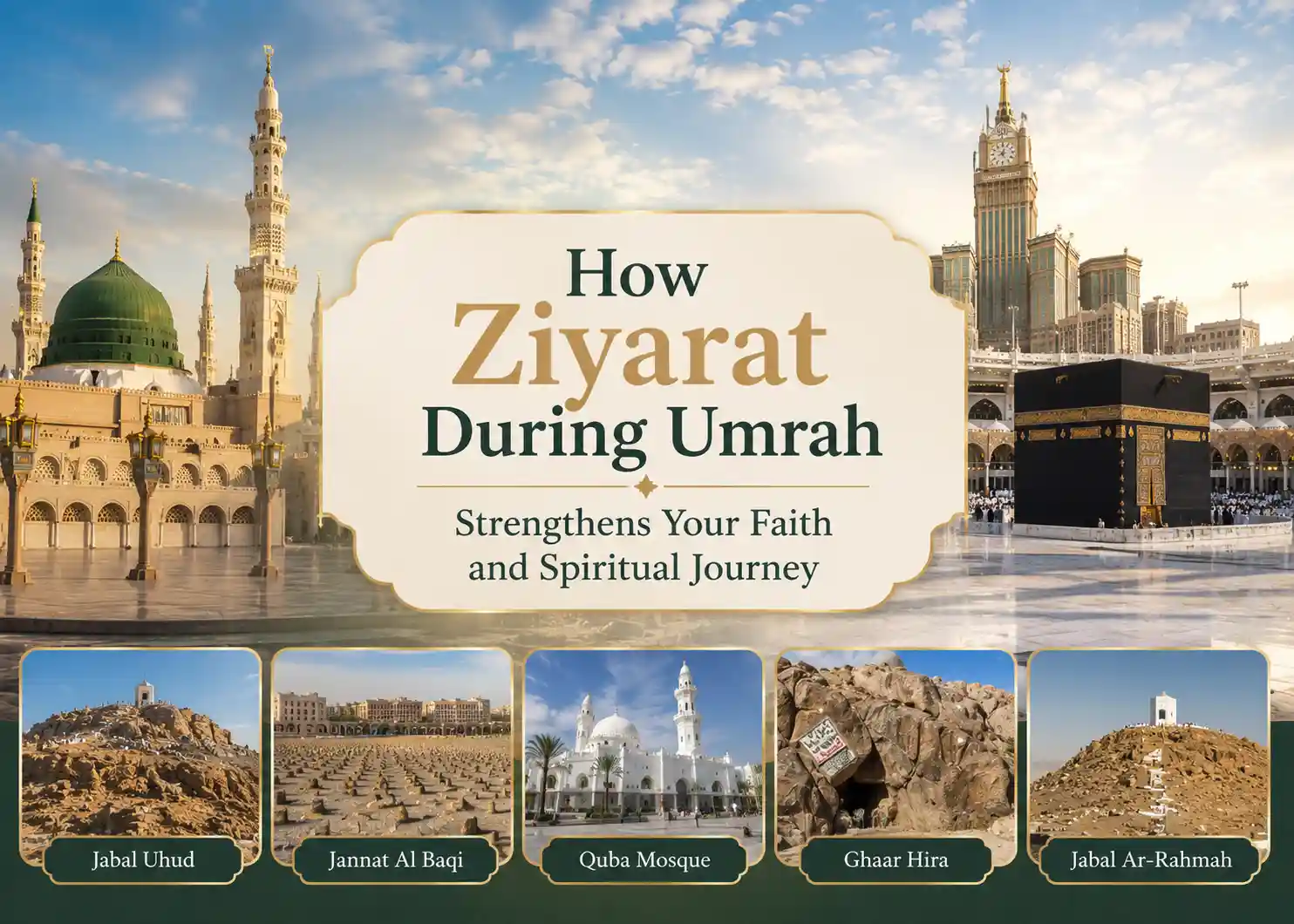
Umrah cleanses the believer from sins with Tawaf, Sa’i and sincere worship. Ziyarat during Umrah takes that experience even further, connecting pilgrims to the actual sites of Islamic history. While Ziyarat is not one of the rites of Umrah, for many pilgrims it is often one of the most spiritually moving parts of the entire journey.
Walking where the Prophet ﷺ walked. Seeing the cave where revelation began. Standing where the Sahabah once stood. These moments turn history from something read about into something personally experienced.
This article looks at why that happens, what these places represent, and how to approach Ziyarat in a way that adds real spiritual value to your Umrah rather than turning it into another stop on an itinerary. The value isn’t in the locations themselves. It’s in what they remind believers of, and what they inspire pilgrims to carry home.
What Is Ziyarat During Umrah?
Ziyarat means “visit.” In this context, it refers to visiting the historical and religious sites connected to the Prophet ﷺ and early Islam in Makkah and Madinah. It’s separate from the actual rituals of Umrah: Tawaf, Sa’i in Umrah and the trimming of hair, which are what make the Umrah itself valid. Ziyarat isn’t obligatory and nothing about a pilgrim’s Umrah is incomplete without it.
Even so, most pilgrims choose to include it. Being physically present at these sites adds a dimension to faith that reading or watching documentaries doesn’t reach. Many tour operators build Ziyarat into their itineraries because pilgrims often value the chance to connect with Islamic history firsthand and for many, it becomes the part of the trip they remember most vividly once they’re home, simply because it’s less familiar and more emotionally immediate than the rituals themselves.
How Ziyarat Strengthens Faith: Three Stages
The effect of Ziyarat unfolds in stages: first in the moment at the site itself, then in reflection carried through the rest of the journey and finally in habits that outlast the trip entirely. Each stage does different work.
The Immediate Effect: Standing Where It Happened
Standing in a place you’ve only ever read about changes how you experience it. This is the first and most immediate effect, distinct from the reflection that tends to come later.
Reading about the Cave of Hira is one experience; standing near it, aware that revelation began in that setting, is another. The distance between knowing a historical fact and feeling its weight closes quickly at these sites. Many pilgrims describe their du’a here as more focused than usual, simply because the surroundings make it harder to be distracted.
Seeing the physical setting of major events (a mountain, a cave, a battlefield) tends to draw people back to why those events mattered in the first place: sincere devotion under real hardship, from people whose reality was very different from ours. And because many of these sites are physically difficult to reach or plain in appearance, that contrast becomes its own kind of lesson in humility.
During the Journey: Personal Reflection
Many pilgrims describe a similar pattern during Ziyarat. They start comparing their life with what they see. The sacrifice at Uhud naturally raises the question of what one would be willing to sacrifice for one’s own faith .
In Jannat al-Baqi’ pilgrims are more aware of death and the Hereafter than in their daily lives, standing close to the graves of the family and companions of the Prophet ﷺ.
This is where Ziyarat becomes a journey rather than a single moment. Pilgrims often renew their repentance, strengthen intentions they’d let slip and return home more consistent in worship than before they left.
After Returning Home: Lasting Change
The reflection doesn’t end when the visit does. It’s common for pilgrims to describe small, lasting changes weeks or months later: a habit of dhikr that sticks, a prayer that becomes more regular, a patience with family or work that wasn’t there before, all traced back to a single afternoon spent standing somewhere quiet in Madinah.
Having stood where early Muslims faced real hardship for their faith, it becomes harder to justify minor excuses for neglecting worship at home. The self-examination that starts at a site like Cave of Thawr or Mount Uhud doesn’t have to end there.
Rather than a one-time spiritual high, the goal is that specific habits (more consistent prayer, more sincere du’a, more remembrance of Allah) continue well past the journey, alongside a gratitude that isn’t tied to the trip itself.
Historic Islamic Sites and the Lessons They Teach
Rather than treating these locations as stops on a tour, it helps to think about what each one represents.
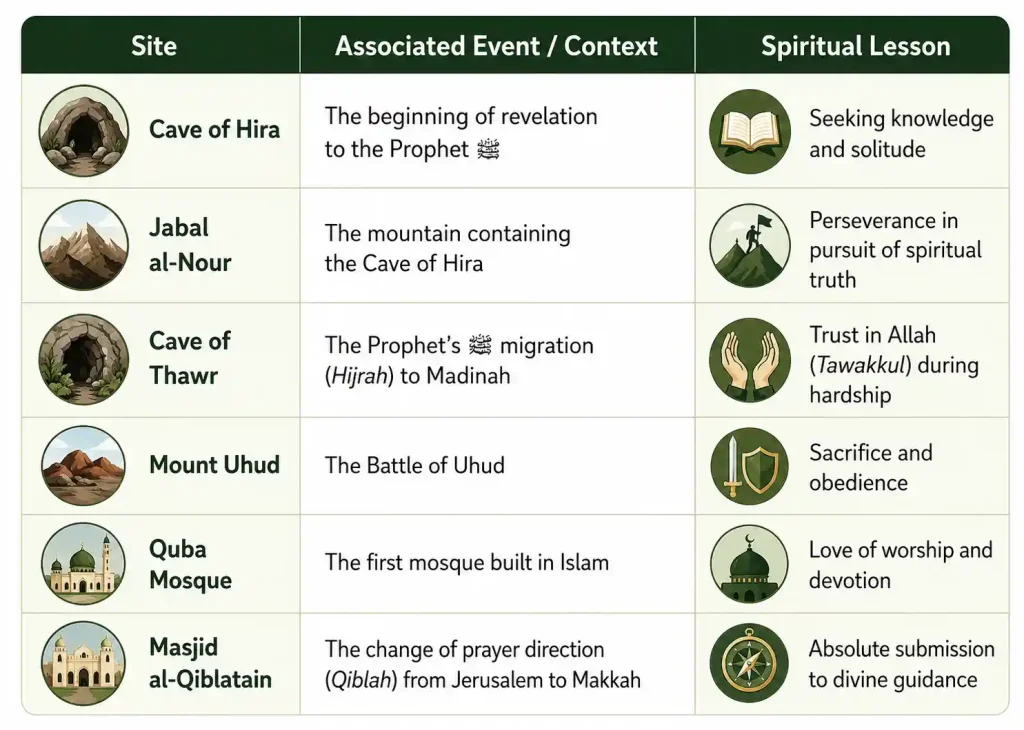
These associations are widely documented in the Seerah and in classical and contemporary Islamic scholarship. The sections below cover each one in more detail: what happened there and what it’s generally understood to reflect.
Ziyarat Sites in Makkah
Cave of Hira
The Cave of Hira sits near the summit of Jabal al-Nour, a short distance outside Makkah. The Seerah widely reports that the Prophet ﷺ would retreat here before prophethood to reflect in solitude and that it was here the first revelation came to him.
The climb is demanding and the cave itself is small, a detail that tends to stay with people who make the trip. It’s a physical reminder that the beginning of Islam did not take place somewhere grand.
Cave of Thawr
Located on a mountain south of Makkah, the Cave of Thawr is where the Prophet ﷺ and Abu Bakr (may Allah be pleased with him) took shelter during their migration to Madinah while being pursued by those seeking to stop them, as recorded in the Seerah.
The Qur’an refers to this moment (9:40), where the Prophet ﷺ reassured Abu Bakr that Allah was with them. For pilgrims, this site is often associated less with the physical difficulty of the climb and more with trust in Allah at a moment when the outcome was genuinely uncertain.
Jabal al-Nour
This is the mountain that contains the Cave of Hira and the two are usually discussed together. Its significance is tied entirely to what happened near its peak: the period of reflection that preceded revelation and the revelation itself.
Jannat al-Mu’alla
This cemetery in Makkah is the resting place of a number of the Prophet’s ﷺ family members, including his first wife, Khadijah (may Allah be pleased with her). It’s quieter than the other sites and pilgrims often use it for remembrance of death and du’a for the deceased, in line with the general Islamic practice of visiting graves as a reminder of the Hereafter.
Ziyarat Sites in Madinah
Quba Mosque
Quba Mosque holds a distinct place in Islamic history as the first mosque built after the Hijrah, constructed in the earliest days after the Prophet ﷺ arrived near Madinah. Authentic hadith mention the reward associated with performing prayer there. It stands as a marker of the very start of the Muslim community’s life in Madinah. Worship was one of the first things established, even before anything else was settled.
Masjid al-Qiblatain
The name means “Mosque of the Two Qiblas.” It marks the location where, according to the Seerah, the Prophet ﷺ received the revelation instructing Muslims to change the direction of prayer from Jerusalem to the Ka’bah in Makkah, a moment recorded in the Qur’an (2:144). For many pilgrims, this site is tied to the idea of submission: a command was given mid-prayer and it was followed immediately, without hesitation.
Mount Uhud
Mount Uhud was the site of the Battle of Uhud, a major and difficult battle in early Islamic history in which a number of companions, including the Prophet’s ﷺ uncle Hamzah (may Allah be pleased with him), were killed. It’s generally associated with themes of sacrifice, the consequences of a lapse in discipline during battle and the resilience of the early Muslim community after a significant setback.
The Seven Mosques
Near Mount Uhud, several small mosques are historically associated with the Battle of the Trench (Khandaq), where the Prophet ﷺ and his companions dug a trench around Madinah to defend against a large confederation of opposing tribes. These mosques are generally understood as markers connected to that event.
Scholars differ on the significance of visiting them as a specific grouped ritual, so it’s worth approaching this site as a historical location tied to the Battle of the Trench, rather than treating the visit itself as carrying distinct religious status.
Jannat al-Baqi’
Jannat al-Baqi’ is the main cemetery of Madinah and the burial place of a large number of the Prophet’s ﷺ companions and family members. As with Jannat al-Mu’alla in Makkah, it’s associated with remembrance of death and the Hereafter and many pilgrims use the visit for reflection and du’a in line with the general Sunnah of visiting graves.
Performing Ziyarat Correctly
Keep Your Intention Sincere
Ziyarat should be approached with the same sincerity expected of any spiritually significant practice. That means keeping the intention focused on reflection, remembrance of Allah and learning, not simply checking a location off a list. It also means following authentic practice rather than local customs or stories without a clear basis, since a number of unverified narrations circulate around these sites.
Common Mistakes to Avoid
- Treating the visit as sightseeing rather than reflection
- Spending more time taking photos than actually reflecting at the site
- Assuming the locations themselves hold blessing or power, a belief not supported in mainstream Islamic teaching, which holds that blessing comes from Allah, not from a place
- Neglecting prayer or rushing through it to keep moving
- Moving through each site too quickly to actually take anything from it
Prepare Spiritually Before Your Visit
The visit is shaped heavily by what a pilgrim brings to it, which makes preparation worth taking seriously before departure, not just packing logistics.
- Learn the history beforehand so the visit is spent reflecting, not catching up on facts on a phone screen while standing there.
- Read the Qur’anic verses or Seerah passages tied to each place: context deepens what’s felt in the moment rather than leaving it purely emotional.
- Set a clear intention before setting out: this is an act of remembrance, not a stop on an itinerary. Let that shape how the day unfolds.
- Prepare a few du’as in advance, specific to what each site represents, since sincere words come easier when they’ve already been considered rather than reached for on the spot.
Conclusion
The value of Ziyarat isn’t measured by how many places a pilgrim manages to visit. It’s measured by what they take from those places and carry home. A cave, a mountain, a small mosque, a cemetery: none of these hold power on their own. What they offer is a reminder of the sacrifice, patience, sincerity and complete trust in Allah. The trust that was shown by the people who lived through the events tied to these locations. Approached with the right intention, Ziyarat can turn Umrah from a journey of rituals into something that continues to shape a person’s faith long after they’ve returned home.
Planning a Ziyarat Trip
If you’re planning to go for Umrah and want to include Ziyarat, it’s worth choosing an itinerary that allows time for reflection rather than rushing from one place to another.
A meaningful Ziyarat isn’t about how many landmarks you check off. It’s about having enough time at each one to actually pause, reflect and connect it to the lesson it carries. That’s the balance Al Zowar Travel designs our Umrah packages around: time for the rituals and time for the history to mean something. Whether you’re traveling as a family, keeping to a budget, or want a bit more comfort along the way, our packages are built to leave room for a journey that shapes you well after you’ve come home.