
If you’re getting ready for Umrah, one of the first things you’ll do after putting on Ihram is recite Talbiyah in Umrah, the call that really kicks off the whole journey. It’s a short phrase, but it carries the weight of everything ahead. The moment you say it, you’re answering an invitation from Allah Himself. This guide walks through what it means, when to say it, and where it comes from in Islamic history, in plain, simple words.
The Real Meaning Behind Talbiyah
Talbiyah in Umrah comes from the Arabic word “labbayka.” It means “here I am”. This way, you openly declare your willingness to answer Allah’s call and serve Him alone. It says “I am here. I am ready to serve You alone.”
Every pilgrim performing Umrah says this. So does every pilgrim performing Hajj. It carries humility, love, and complete surrender to Allah. Say the words, and you can feel it, something in the chest loosens, and the noise of the outside world just quiets down. That’s the real Talbiyah meaning, and it’s worth feeling, not just reciting.
Allah commands this act directly in the Quran:
وَأَتِمُّوا الْحَجَّ وَالْعُمْرَةَ لِلَّهِ
“And complete the Hajj and Umrah for Allah.” (Surah Al-Baqarah 2:196)
Talbiyah is where that completion begins. It’s your first step toward that command.
Talbiyah in Arabic: Words That Touch the Heart
The full Talbiyah in Arabic is:
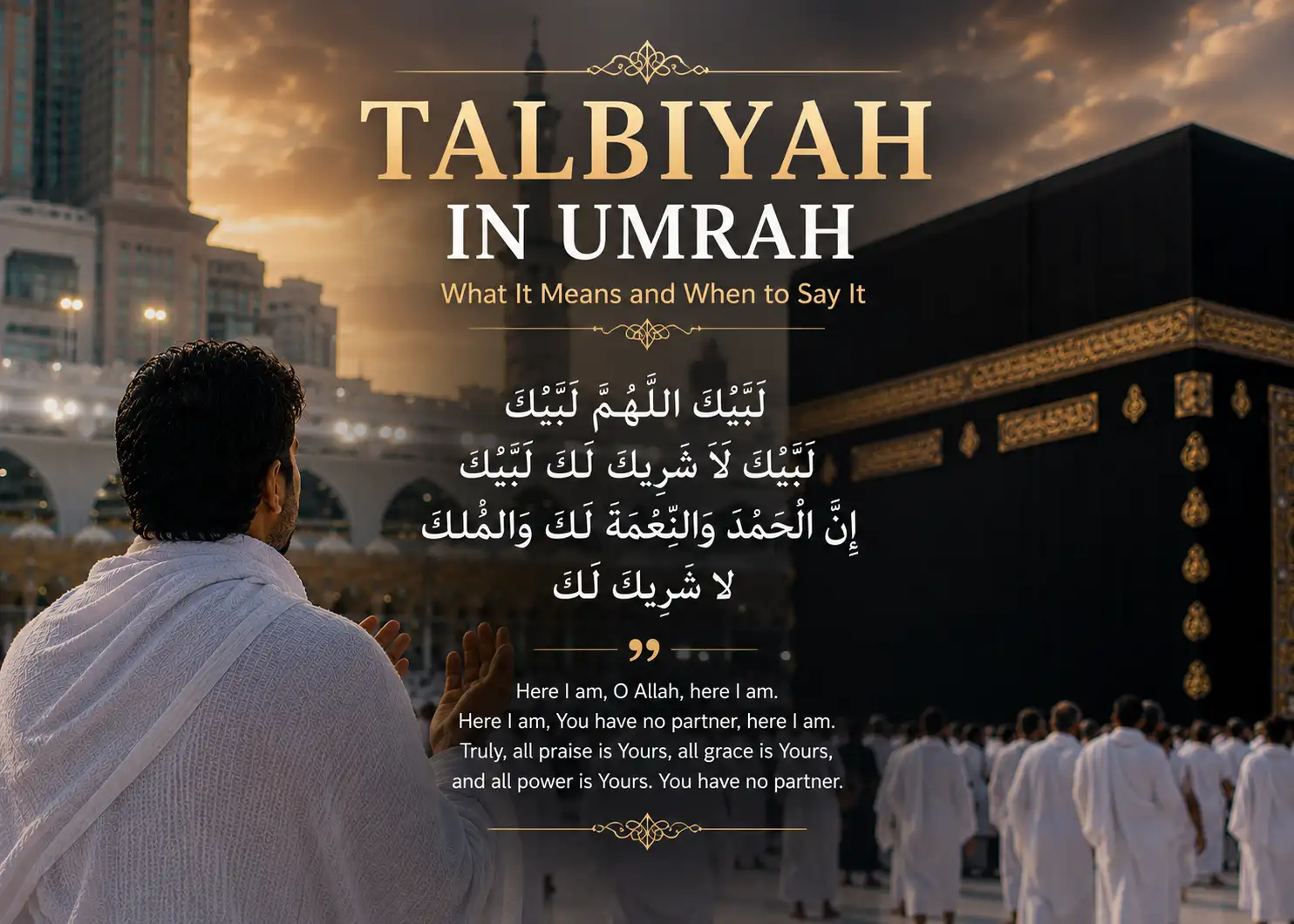
لَبَّيْكَ اللَّهُمَّ لَبَّيْكَ، لَبَّيْكَ لَا شَرِيكَ لَكَ لَبَّيْكَ، إِنَّ الْحَمْدَ وَالنِّعْمَةَ لَكَ وَالْمُلْكَ، لَا شَرِيكَ لَكَ
Talbiyah pronunciation (transliteration): Labbayk Allahumma labbayk, labbayka la sharika laka labbayk, innal hamda wan ni’mata laka wal mulk, la sharika lak.
Talbiyah translation in English: Here I am, O Allah, here I am. Here I am, You have no partner, here I am. Truly, all praise is Yours, all grace is Yours, and all power is Yours. You have no partner.
This exact wording comes from Sahih Bukhari, Hadith 1549, and Sahih Muslim, Hadith 1184. Abdullah ibn Umar (RA) narrated that the Prophet ﷺ used these very words every time. Learn the Talbiyah pronunciation before your trip, so it comes out naturally when your heart is already racing with emotion.
Answering Allah’s Call: The Heart of Talbiyah
When you say Talbiyah during Umrah, you’re accepting an invitation that goes back thousands of years, one Allah gave to Prophet Ibrahim (AS). Allah speaks to this directly in the Quran, in words addressed to Ibrahim (AS) himself:
وَأَذِّنْ فِي النَّاسِ بِالْحَجِّ يَأْتُوكَ رِجَالًا وَعَلَىٰ كُلِّ ضَامِرٍ يَأْتِينَ مِن كُلِّ فَجٍّ عَمِيقٍ
“And proclaim to mankind the Hajj. They will come to you on foot and on every lean camel, coming from every distant pass.” (Surah Al-Hajj 22:27)
That call was never meant for one group. It reaches every believer, in every generation, including you, right now. Saying Talbiyah is how you answer it.
Why Talbiyah Moves the Soul
Talbiyah for Umrah carries real spiritual weight. Scholars say saying it often builds sincerity and strips away pride. More than anything, it reminds you that Allah alone holds power.
Notice the phrase “la sharika lak,” meaning “You have no partner.” It repeats twice, and that’s not by accident. It erases any lingering doubt about Allah’s oneness before it can even take root.
Raising the voice is also Sunnah for men. The Prophet ﷺ said:
أَتَانِي جِبْرِيلُ عَلَيْهِ السَّلَامُ فَأَمَرَنِي أَنْ آمُرَ أَصْحَابِي أَنْ يَرْفَعُوا أَصْوَاتَهُمْ بِالتَّلْبِيَةِ
“Jibreel came to me and ordered me to instruct my companions to raise their voices in Talbiyah.” (Reported by Ibn Majah, Hadith 2922)
A loud voice here isn’t just permitted. It’s rewarded. Women, on the other hand, recite it softly, just loud enough to hear themselves.
There’s a wider lesson in the Quran too. Allah says:
لَن يَنَالَ اللَّهَ لُحُومُهَا وَلَا دِمَاؤُهَا وَلَٰكِن يَنَالُهُ التَّقْوَىٰ مِنكُمْ
“Their meat will not reach Allah, nor will their blood, but what reaches Him is piety from you.” (Surah Al-Hajj 22:37) That verse is about the Hajj sacrifice, but the principle carries over to Talbiyah just as well. Allah isn’t collecting your words. He’s watching the sincerity behind them.
A Call That Began with Prophet Ibrahim (AS)
Talbiyah in Umrah goes all the way back to Prophet Ibrahim (AS). He and his son Ismail (AS) raised the Kaaba with their own hands, stone by stone. When it was finished, Allah gave him one more task: stand up and call people to Hajj, even though no crowd had gathered yet, even though he had no way of knowing who, if anyone, would answer. Ibrahim (AS) climbed up and called out, and his voice reached far beyond what he could see, all the way to us, generations later.
Every pilgrim who recites Talbiyah today is answering that very call. That’s what makes Umrah more than a ritual. That link is real. Say Talbiyah, and you’re standing in a line that goes back to prophets you’ve only ever read about.
Walking in the Footsteps of the Prophet ﷺ
Prophet Muhammad ﷺ recited Talbiyah nonstop, throughout both His Umrah and His Hajj. His companions recalled that he never paused, not from the moment of Ihram until he reached the Kaaba.
Following his example brings real reward. He ﷺ said, “There is no Muslim who recites the Talbiyah, but everything on his right and left, stones, trees, and soil, recites the Talbiyah with him, until the earth is cut off from here and there.” (Reported by Tirmidhi, Hadith 828)
Your voice, in other words, is never really alone out there.
The Perfect Moment to Begin Talbiyah
Start reciting Talbiyah in Umrah the moment you reach the Miqat and enter Ihram. The Miqat is a fixed boundary point, and pilgrims from different regions have their own. Once you’re in Ihram and you’ve made your intention, or niyyah, begin right there.
Pilgrims travelling through Al Zowar Travel’s Umrah Packages 2026 get clear guidance on their exact Miqat well before they even pack their bags. It’s a small detail, but it makes a real difference once you’re actually standing there, unsure, with everyone waiting on you.
How Often Should You Recite Talbiyah?
There’s no set number. Scholars simply encourage saying it often, walking, resting, travelling toward Makkah, whenever you get the chance.
The more you say it, the more your heart stays anchored to why you’re there. Many scholars suggest reciting it after each prayer, or whenever the landscape changes, climbing a hill, descending into a valley. Keep it going, and your intention stays fresh the whole way.
When Should You Stop Reciting Talbiyah?
For Umrah, keep reciting until Tawaf begins. Once your first circuit around the Kaaba starts, stop, and shift your focus to the words of Tawaf instead.
That switch marks something significant. Your journey toward Allah’s house finally turns into worship itself. First time pilgrims often feel it hit hard here, years of hope suddenly becoming real.
How Talbiyah Prepares Your Heart for Umrah
Umrah tests more than the body. It tests patience, focus, and endurance, and Talbiyah helps carry you through all three.
Every time you recite it, something in your mind resets. The noise of daily life fades a little, and your thoughts drift back toward Allah, over and over, for the length of the journey.
Many pilgrims talk about a strange calm that settles somewhere between the Miqat and Makkah. Talbiyah in Umrah plays a real part in that. The rhythm of the words seems to slow your breathing, and your thoughts along with it.
This is why scholars describe Talbiyah as a form of dhikr, or remembrance of Allah. Every repetition builds it, one phrase at a time.
Allah promises something in return:
فَاذْكُرُونِي أَذْكُرْكُمْ
“So remember Me; I will remember you.” (Surah Al-Baqarah 2:152) Every Talbiyah you whisper gets remembered too, and Allah answers it with His own remembrance.
Umrah Talbiyah vs Hajj Talbiyah: What Changes?
The words are identical for both. Only the timing shifts. During Umrah, you stop reciting once Tawaf begins. During Hajj, it continues for several days, right up until the stoning of Jamrah al-Aqabah on the day of Eid.
Knowing this difference saves confusion, especially for anyone doing Umrah now and planning Hajj down the road.
Common Mistakes While Reciting Talbiyah
New pilgrims often feel unsure at first. Some stop reciting Talbiyah too early. Others mix up the Arabic, or forget to say it again after their direction changes.
Practicing the Talbiyah translation and pronunciation ahead of time solves most of this. A pilgrim who’s prepared enjoys the moment far more than one who’s rushing to remember the words.
Feeling shy about reciting loudly is common too, especially somewhere unfamiliar. Start softly if that’s what feels natural. Your confidence tends to build with each repetition, and honestly, nobody around you is paying that much attention to your pace.
The Prophet ﷺ reminded us that faith brings ease, not pressure. He said:
الدِّينُ يُسْرٌ، وَلَنْ يُشَادَّ الدِّينَ أَحَدٌ إِلَّا غَلَبَهُ
“The religion is ease, and no one overburdens himself in it except that it overwhelms him.” (Reported by Sahih Bukhari, Hadith 39) Keep that in mind. Talbiyah in Umrah is meant to bring you peace, not stress.
Simple Talbiyah Tips for First Time Pilgrims
Umrah can feel like a lot at first. These small habits go a long way toward keeping you calm and ready.
- Memorise the Talbiyah before you travel.
- Learn the meaning of each line first.
- Carry a small card with the transliteration.
- Ask your group leader about your exact Miqat point.
- Recite Talbiyah in a natural, steady voice.
Families travelling together often need a bit of extra support, which is exactly what Al Zowar Travel’s Umrah for Ladies packages are built for, offering real help for women pilgrims at every step.
Still weighing your options? It’s worth browsing the full range of Umrah deals before you decide, so you land on something that actually fits your budget and comfort.
The Lasting Power of Talbiyah
Talbiyah isn’t a small formality tucked into the ritual. It shapes your mindset from the very first step, and scholars have taught this for generations. A sincere Talbiyah in Umrah softens the heart and readies it for everything ahead.
Allah accepts every sincere call and welcomes every humble believer. Trust in that, fully, and let it guide every word that leaves your mouth.
The Prophet ﷺ described the real reward waiting here. He said:
الْعُمْرَةُ إِلَى الْعُمْرَةِ كَفَّارَةٌ لِمَا بَيْنَهُمَا، وَالْحَجُّ الْمَبْرُورُ لَيْسَ لَهُ جَزَاءٌ إِلَّا الْجَنَّةُ
“Umrah to Umrah is an expiation for what is between them, and Hajj Mabrur has no reward but Paradise.” (Reported by Sahih Bukhari, Hadith 1773, and Sahih Muslim, Hadith 1349) Talbiyah is the door to that reward. It’s where your sincere intention first finds its voice.
Final Thoughts: Your Journey Begins with These Words
You won’t fully grasp the weight of Talbiyah in Umrah from reading about it. That part comes later, standing at the Miqat with your own voice saying the words for the first time.
It’s a genuine declaration of devotion, humility, and love for Allah. It ties you directly to Prophet Ibrahim (AS) and the Sunnah of Prophet Muhammad ﷺ. Learning it before you travel keeps your heart calm and focused once you actually arrive.
Take the time now. Learn the words, understand what they mean, and practise the pronunciation until it feels like your own. When you’re ready to begin this journey, Al Zowar Travel is here to walk through it with you, from booking Umrah packages to Ihram and every step that follows.