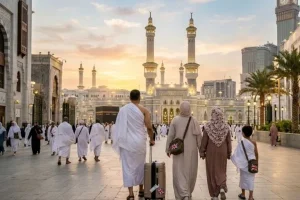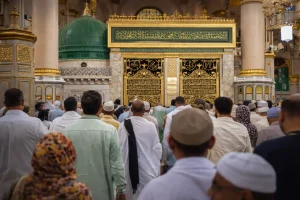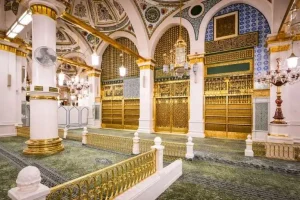
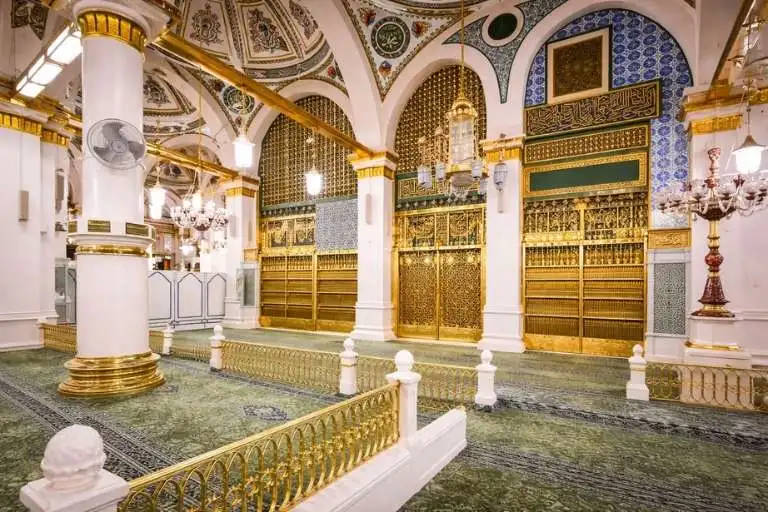
Rawdah (Riyad ul-Jannah) is the blessed area between the Prophet’s ﷺ house and his pulpit, described in authentic hadith as “a garden from the gardens of Paradise.” Today, Umrah Travellers reach it by booking a permit through the official Nusuk system, then entering calmly at their allotted time, praying briefly, sending salawat, making heartfelt dua, and leaving space for others.
For many Umrah Pilgrims, Madinah is the part of the journey that quietly steals the heart. You land thinking mainly about Makkah and Umrah, but then you walk into Masjid an-Nabawi, see the green dome, and hear people whisper about a place called Rawdah, “a garden from the gardens of Paradise.”
At the same time, you hear stories that make you a bit nervous: queues, crowds, strict timings, and separate slots for men and women. You might wonder: How do I visit Rawdah properly? What should I do there? And how do I honour the Prophet ﷺ and the people around me, instead of just chasing a selfie on the green carpet?
This guide will walk you through what Rawdah is, how to access it with current rules, and how to visit in a way that fills your heart without disturbing anyone else.
What Is Rawdah in Madinah and Why Is It So Special?
Rawdah, also known as Riyad ul-Jannah, is located inside Masjid an-Nabawi, between the Prophet’s ﷺ original home and his pulpit (minbar). In multiple authentic narrations, the Prophet ﷺ said:
“Between my house and my pulpit, there is a garden from the gardens of Paradise.”
Scholars explain that this means the area is a special place of mercy, tranquillity, and acceptance, or that worship there is a means that leads to Paradise. Inside the mosque, Rawdah is clearly marked: the carpet changes from red to green, and certain pillars are well-known to local guides and students of knowledge as “Pillar of Aisha,” “Pillar of Repentance,” and others.
For a modern pilgrim, especially those arriving on structured Umrah Packages, stepping into this small rectangle of green carpet can feel overwhelming. Generations of believers have stood exactly there, praying, repenting, and sending salawat. It’s not a tourist stop; it’s a tiny piece of the Prophet’s ﷺ daily life, preserved inside the mosque.
How Do Umrah Pilgrims Visit Rawdah Today?
Because millions of people now perform Hajj and Umrah each year, Saudi authorities control access to the Rawdah to prevent the area from becoming dangerously overcrowded.
The general process for visiting Rawdah Rasol today works like this:
- You download the official Nusuk app (Android or iOS).
- You create an account and link it to the visa you used to enter Saudi Arabia (Umrah visa, tourist visa, etc.).
- Inside the app, you scroll to Prophet’s Mosque Services and choose “Praying in the Noble Rawdah”.
- You select your gender, choose a date and time from the available slots, and confirm.
- The app generates a QR permit, which you show to security staff when it’s time to enter the Rawdah route.
Rules and time slots have changed a few times over recent years, including new “instant track” options that allow visitors to book when they are physically close to Masjid an-Nabawi.
It’s important to stress one thing for Umrah Travellers:
Your Umrah Packages cannot “guarantee” Rawdah entry. The permit is free, personal, and issued by the authorities. A good agency can guide you, but no one can bypass the system.
Men’s and Women’s Visiting Times – What to Expect
Men and women visit Rawdah in separate groups and usually use different entry routes. Current practice (which can change) allocates each group windows during the day and night. Recent announcements, for example, mention men visiting between roughly 2:00 a.m. and Fajr, and again late morning until Isha, with women visiting after Fajr until late morning, then again after Isha until around 2:00 a.m.
For you as an Umrah Pilgrim, this means:
- Arrive early for your time, queues form, security checks your QR code, and groups are moved in batches.
- Keep your phone charged and your permit visible; it makes the process smoother for everyone.
Preparing Your Heart Before You Step Into Rawdah
Visiting Rawdah begins long before you touch the green carpet. It starts in your hotel room, on the coach to Madinah, and even back in the UK when you first decide to travel.
For Umrah Pilgrims, the most powerful preparation is intention (niyyah). Tell yourself clearly: “I am going to Rawdah to seek Allah’s pleasure, to honour His Messenger ﷺ, and to soften my heart, not just to tick a box or take a photo.” That one line can reframe the entire experience.
It helps to arrive in a state of cleanliness and dignity. Many people choose to perform ghusl, wear their cleanest, most modest clothes, and, for men, apply a light, halal perfume before heading to the mosque, just as they would if visiting a noble guest. This is not a rule that invalidates your visit if you miss it, but it is an expression of love and respect.
Fill the journey to the mosque with salawat. Whisper “Allahumma salli ‘ala Muhammad wa ‘ala aali Muhammad” as you walk through Madinah’s streets or across the marble courtyard. Let the heart catch up with the body so that by the time you join the Rawdah queue, you are already calm and connected.
You can also prepare practically: write a small list of duas in your phone, revise a few short surahs, and read a page about the life and character of the Prophet ﷺ. When you finally reach Rawdah, you don’t want to waste half of your short time trying to remember what you meant to ask for.
Inside the Rawdah: How to Pray and What to Do
When the stewards finally open the rope, and your group begins to move, your first job is not to sprint; it is to stay composed. Many people will feel emotional, excited, or anxious about losing the chance. Remind yourself: the One who invited you here is fully in control.
As you enter the Rawdah area, step with humility. There is no need for loud conversation or raised voices. You don’t need to narrate the experience on camera. This small piece of earth has seen more sincere tears and whispered duas than you can imagine; add yours quietly to that history.
If you find a spot where you can stand without blocking others, begin with a short prayer. Many scholars recommend praying two units of voluntary prayer (nafl), such as Tahiyyatul Masjid, if you have not already prayed them, using whatever short surahs you know, and keeping your posture and gaze focused.
After that, give your time to dua and dhikr. This is where the preparation pays off. Ask Allah for forgiveness near what is known as the “Pillar of Repentance” if you are able to reach it, but do not fight or push to get there; Allah hears you from any part of Rawdah, and your humility may be more beloved to Him than the exact metre of floor you occupy.
Send abundant salawat upon the Prophet ﷺ. Remember that he prayed in this area, taught in this mosque, and carried concern for his Ummah until his final breath. Let your heart respond to that care with gratitude and love.
Finally, remember that your visit has a time limit. Security staff will gently move groups along so everyone can have a chance. That short time, if filled with presence and sincerity, is more valuable than half an hour spent elbowing through the crowd.
Spiritual Etiquette: What to Avoid in Rawdah
The Rawdah is not just “another nice corner” of the mosque. It is a place of worship, and the adab (manners) that apply there are serious.
-
Directing Acts Of Worship To The Grave.
Do not prostrate towards the tomb, press your face or hands against the walls or gates, or make dua to the Prophet ﷺ. Your dua is always to Allah alone, and you are only using this blessed place as a means to draw closer to Him.
-
Be Careful With Phones And Photos
Security staff increasingly discourage photography in Rawdah because it distracts people and invades others’ privacy. More importantly, your heart can only be fully present in one place: either in the camera frame or with Allah. Try to choose the latter.
-
Control Your Body Language
Don’t push, shove, or cut queues, no matter how badly you want to touch the green carpet. Patience, in that moment, is itself an act of worship and may be the very reason Allah invited you there.
Lastly, dress and conduct yourself as you would in front of a beloved teacher and a strict king at the same time: dignified, modest, steady. Your clothing should be clean and loose; your speech low and respectful; your movements slow and considerate.
Best Times and Practical Planning for Umrah Travellers
Because Rawdah is small and demand is very high, timing is one of the most important practical decisions for Umrah Pilgrims. Traditionally, late-night slots and the very early hours around Fajr tend to be calmer for men, while mid-morning or later evening can sometimes be gentler for women, but this varies with season and crowd levels.
In some phases, pilgrims book specific dates and times up to several days in advance; in others, the focus is on real-time “Instant Track” booking when your GPS shows you are near Masjid an-Nabawi. This means planning your Rawdah visit is less about guessing “quiet” hours and more about:
- Allowing enough days in Madinah within your Umrah Package to try for multiple slots if needed.
- Keeping your schedule flexible, especially in the first couple of days, so you can accept whatever permit time you receive.
- Coordinating with family members, especially elderly parents, so they can rest before and after the visit.
For older pilgrims or those with health issues, weekday morning slots and off-peak seasons can make a big difference. The reward is not reduced if you avoid the highest-traffic hours; in fact, being able to stand and focus calmly may increase the quality of your worship.
Closing Thoughts!!
Not everyone is given the chance to stand on those few metres of green carpet. If Allah opens that door for you, accept it with gratitude, not entitlement. Whether your time in Rawdah lasts five minutes or fifteen, it is the state of your heart that will be written in your record, not the number of photos you took or how close you got to a particular pillar.
If you are now planning your own trip and want to build a journey that leaves enough space in Madinah for a calm Rawdah visit, with time to try more than once if needed, it helps to travel with people who understand both the logistics and the spirituality. You can book your Umrah journey with a trusted UK-based agency like Al Zowar Travel, so flights, hotels, and transfers are handled professionally, and you are free to focus on what really matters: walking into Masjid an-Nabawi as a guest of Allah and His Messenger ﷺ, with a heart ready to be changed.