If you reside in the UK, you’ve probably heard the words “Hajj” and “Umrah” combined a lot. Friends post pictures from their most recent Umrah trip, and parents talk about “saving for Hajj one day.” Both trips go to Makkah, both focus on the Ka’bah, and both can fundamentally change how you see your life. But Hajj and Umrah are not the same, and that difference is quite important if this is your first pilgrimage.
Hajj is the most important pilgrimage that everyone must make once a year on set days in Dhul Hijjah. Umrah, on the other hand, is a shorter, more flexible pilgrimage that can be done most of the year. One is a required part of Islam (Hajj), and the other is a highly recommended Sunnah (Umrah). Both can touch your heart in ways you don’t expect.
This guide tells you what the difference is between Hajj and Umrah. By the end, you’ll know what each trip entails, how they effect your decision of Hajj Packages or Umrah Packages, and which trip would be best for you right now.
What is Hajj?
Hajj is one of the five most important things in Islam. Not only is it a good idea to go on this voyage, but every adult, sane, financially stable, and physically competent Muslim must do it at least once in their lifetime. When those things happen, Hajj is no longer just a thought on a vision board; it becomes a concrete duty you have to do for Allah.
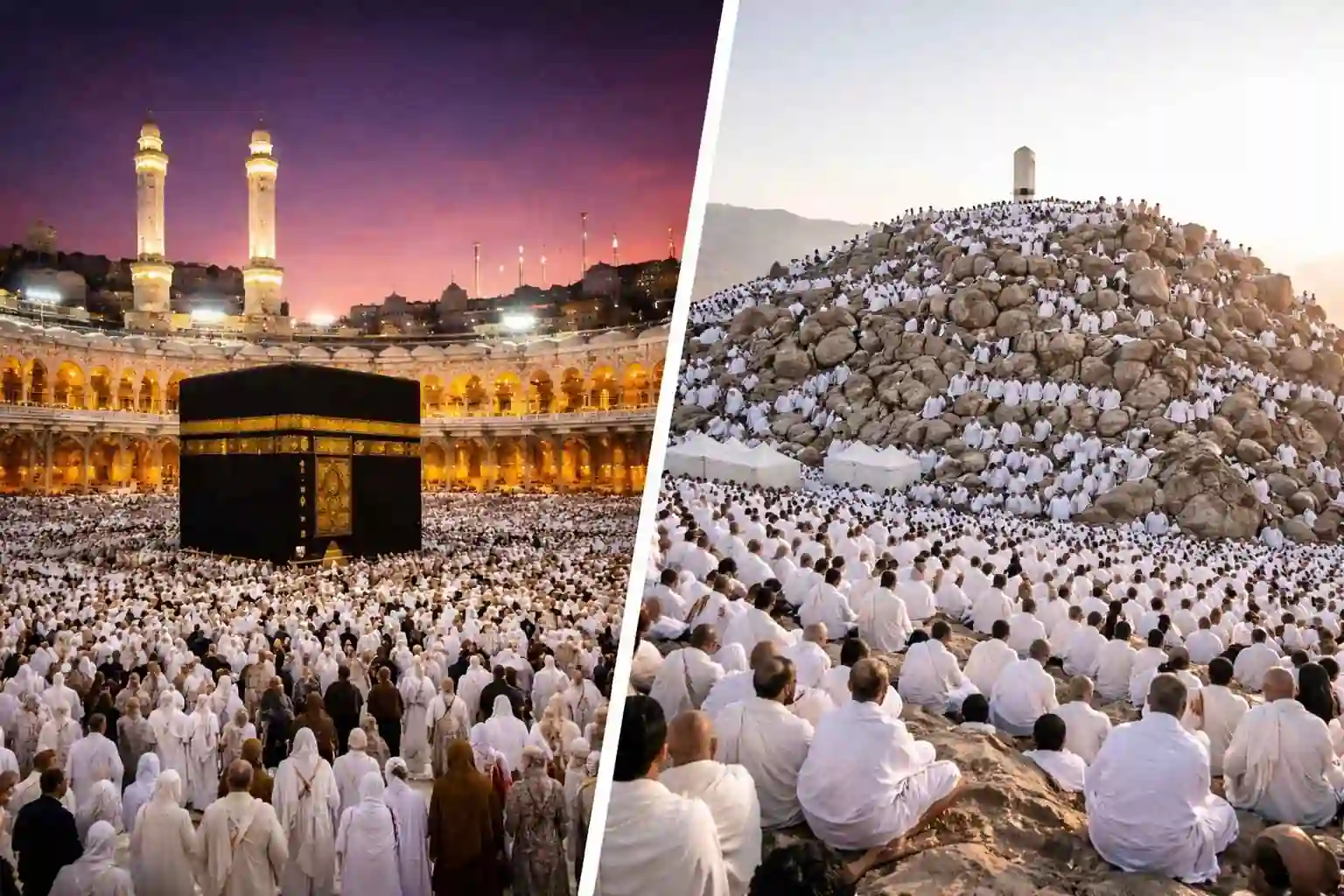
Hajj happens on certain days of the last month of the Islamic calendar, Dhul Hijjah, from the 8th to the 12th or 13th. During those days, millions of Muslims come to Makkah and the area around it to take part in a series of planned ceremonies. Pilgrims enter the state of ihram, circle the Ka’bah, and walk between Safa and Marwa, but they also do other things like stand at Arafat, spend the night in Muzdalifah, remain in Mina, and throw stones at the pillars known as Jamarat. These added steps are what make Hajj longer, harder, and more intense.
Hajj normally requires a lot of planning for Muslims in the UK. You can’t just select dates and book a cheap airfare. You have to book your Hajj through official methods, choose among structured Hajj Packages, and get your body and mind ready for many days of heat, crowds, and constant movement. It requires a lot of you, but it also gives you a lot in return.
What is Umrah?
People sometimes call Umrah the “lesser” or “minor” trip, but that doesn’t imply it’s not important emotionally or spiritually. It is a shortened series of ceremonies that can be done in Makkah nearly any time of year, except for the main Hajj days. Umrah is not one of the Five Pillars, but it is a Sunnah that the Prophet (peace be upon him) did many times and highly advocated.
Umrah’s basic structure is easy to understand. You enter ihram from a miqat, make your intention, and then, when you get to Makkah, you do Tawaf around the Ka’bah and then Sa’i between Safa and Marwa. In the end, men shave or cut their hair, and women cut a small piece of their hair. After that, your Umrah is over and you can leave the condition of ihram. A lot of individuals can do these ceremonies in a few hours, but they might stay in Makkah and Madinah for days to really take it all in.
From the UK’s point of view, Umrah is usually more flexible. People who are going on Umrah can look at different Umrah Packages and Umrah Deals, pick a period that works with their school holidays or yearly leave, and decide how long they want to stay in each place. For many families, this is the first time they’ve tasted the Haramain before they decide to go on Hajj.
Important Differences Between Hajj and Umrah
Let’s look at how the two rituals are different:
Duty and Importance
The most important difference between Hajj and Umrah is how required they are. Hajj is required for those who meet the requirements. It is one of the five pillars of Islam, along with prayer and fasting during Ramadan. You should go on Hajj at least once in your life when you can. It is strongly discouraged to put it off without a good reason.
Umrah, on the other hand, is not required in the same way. It is a Sunnah and a highly rewarding act of worship, but it is not as important as Hajj. Some Islamic schools say it’s necessary, while others say it’s highly recommended. But they all agree that it’s really good for the heart. The most important thing to remember when preparing is that Umrah does not take the place of Hajj. You still have to do Hajj if you can, even if you undertake Umrah many times.
You could say that Hajj is the foundation of your faith and Umrah is a way to renew that foundation every time Allah opens the door.
When and for how long
The time is another big difference. During the days of Dhul Hijjah, you can only do Hajj. That is set in stone in the Islamic calendar and happens once a year. If you choose a Hajj Package, everything will be based on those dates, and it appears like everyone in the world comes to Makkah at the same time.
Umrah, on the other hand, lets you do a lot more. You can do it in most months of the year, including during a peaceful time at school, a half-term break, the winter holidays, or the particular ambiance of Ramadan. Once you’re there, you may normally do the main rites of Umrah in 3 to 6 hours. Hajj, on the other hand, usually takes five or six days of nonstop activities, with travel days on either side.
For a family in the UK that needs to deal with job, education, health issues, and funds, the timing and length of things are frequently the most crucial things. Hajj is a significant deal in your life that needs a lot of time and attention. Umrah, on the other hand, is a deep spiritual retreat that fits better into your year.
Rituals and Complicatedness
Entering ihram, doing Tawaf, finishing Sa’i between Safa and Marwa, and shaving or cutting the hair are all things that both Hajj and Umrah have in common. When friends and family return back from their trips, these are the things you usually see in pictures and videos.
But Hajj has a lot more layers than Umrah. You spend a lot of time in Mina on Hajj, you stand on the plains of Arafat pleading for forgiveness in the sun, you sleep outside in Muzdalifah, and you throw stones at Shaytan at the Jamarat. There is also the sacrifice that commemorates Eid al-Adha and more Tawaf before you go.
Umrah is all about the holy center of Makkah, while Hajj takes place across many days and in many places. The logistics are harder, the movement is faster, and the experience is harder on both the body and the mind. This is one reason why a lot of individuals want to do Umrah before Hajj, especially if they have health problems or have never been to Saudi Arabia before.
Travel Packages, Costs, and Logistics
Hajjis are almost always more expensive and complicated than Umrah since they take longer, are bigger, and have more rules. Most Hajj packages include flights to and from other countries, lodging in Makkah and Madinah, tents in Mina and Arafat, transportation within the country, meals in some places, and staff or guides to help. Hajj Booking normally needs to be done far in advance because there are quotas, official processes, and rules to follow.
Umrah is usually easier to arrange and pay for than Hajj. Umrah packages come in a wide range of prices, from cheap ones with basic lodgings to more expensive ones with hotels right adjacent to the Haram. You can typically choose how long your journey will be and what kind of hotel you want to stay in. You can also mix and match nights in Madinah and Makkah, and take advantage of seasonal Umrah Deals when costs go down. Many Muslims in the UK go on Umrah trips at different times in their lives, including as when they are newlyweds, when they have young children, or when they are older and retired.
Spiritual Reward
The benefits of Hajj and Umrah are great, yet they are talked about in different ways. Hadith says that an acceptable Hajj, which is also known as Hajj Mabrur, has no recompense other than Paradise. If Allah accepts your Hajj, it can wash out all of your sins and start your record over in a very special way.
Umrah is not one of the five pillars, but it does provide a big reward. It is known to erase sins between one Umrah and the next and to bring the servant closer to Allah via sincere dua, tawbah, and humility. Some stories say that Umrah during Ramadan offers a reward like Hajj, although this is only about reward and does not mean that Hajj is not required.
If Allah accepts it, you could think of Hajj as a “full reset” that happens once in a lifetime. Umrah, on the other hand, is a strong, recurrent spiritual deep clean that keeps your heart warm and connected.
Hajj vs. Umrah: A Quick Look to Help You UnderstandHajj and Umrah: What You Have to Do and What It MeansOne of the five main parts of Islam. Every adult Muslim must do this at least once in their life if they are able to do it physically, psychologically, and financially.A Sunnah that is highly encouraged. Not a pillar like Hajj. You can do it more than once.
Only throughout the 8th to 12th (or 13th) Dhul Hijjah of each year. Dates that don’t change.It can be done most of the year, except for the main Hajj days. A lot more flexible.
Average Time (on the ground)
Five to six days of planned ceremonies, plus days of travel and rest.Most people who go to Makkah or Madinah remain for 5 to 14 days, however the core ceremonies normally take 3 to 6 hours.
Core rituals include Ihram, Tawaf, Sa’i, shaving or clipping hair, standing at Arafat, spending the night in Muzdalifah, days in Mina, throwing stones at the Jamarat, Qurbani, and saying goodbye Tawaf.Ihram, Tawaf around the Ka’bah, Sa’i between Safa and Marwa, and shaving or cutting the hair. Less work, easier flow.
Spiritual Status: If you accept Hajj Mabrur, you will not get any rewards save for Jannah, and it can wipe out all of your sins from your whole life.It cleanses sins between one Umrah and the next and draws the servant closer to Allah. Umrah during Ramadan is like Hajj in that it is a good deed, but it does not replace the need to complete Hajj.
High physical demand: long walks, heat, big crowds, staying outside or in tents overnight, and moving between sites (Mina, Arafat, Muzdalifah).Moderate, depending on the season and how many people are there. Most of the time, people walk during Tawaf and Sa’i, and they also move around the Haramain.
Average Cost from the UK (per person) Changes by Year and Standard. Most UK Hajj packages cost between £7,500 and £10,000 per person, with budget packages at the lower end and VIP/5-star packages at the upper end.Most Umrah packages from the UK cost between £600 and £700 for basic or off-peak rates. The average cost is between £800 and £900, whereas excursions with 4–5 stars or during peak/Ramadan season cost more than £1,000 per person.
Visa Type: Hajj visa or an approved route for the specific Hajj season, which are commonly included in official packages.Umrah visa or a valid visit or tourist visa, depending on Saudi Arabia’s current restrictions. Usually, it’s easier and faster to set up.
Hajj and Umrah Have Things in Common
Hajj and Umrah are very different, but they have a lot in common. Both will take you to Makkah, a holy city in Saudi Arabia. For each, you have to enter a specific state called ihram, when you put aside your customary habits and clothes in favour of simplicity and attention. They include Tawaf surrounding the Ka’bah, which is the center of the Muslim universe, and Sa’i between Safa and Marwa, which is based on Hajar’s search for water for her kid.
More importantly, these are trips that are meant to take you away from your everyday life and put you right in front of Allah with as little distractions as possible. The main goal of both Hajj and Umrah, whether you go for five days or just a weekend, is the same: to please Allah, ask for pardon, clean your heart, and come home changed.
Which one should you do first: Hajj or Umrah?
A lot of Muslims in the UK are having trouble with this question. The truth is that it depends on your situation. Many scholars would tell you that if Hajj has already become mandatory for you and you have the health, money, and ability to go, you shouldn’t keep putting it off for years without a good reason. In that case, you can look into the best Hajj packages and be ready for the next Hajj season.
But if you’re still saving money, not feeling well, or have never been to Saudi Arabia before, Umrah could be a good first step. It helps you get adjusted to the weather and crowds, discover how Tawaf and Sa’i operate in real life, and experience how your body handles standing and walking. A lot of individuals say that undertaking Umrah first makes them feel less anxious about Hajj later.
In actual life, many families in the UK go on one or two Umrah visits before they arrange their Hajj. The most essential thing is to keep focused on your objective and make sure your plans are realistic so that you’re ready when Allah opens the door.
Useful Tips for People Going on Hajj and Umrah in the UK
When you know the difference between Hajj and Umrah, it is much easier to plan. You can talk to a reliable UK-based Umrah/Hajj travel provider like Alzowar Travel and be honest about your health, budget, family status, and past travel experiences. A competent travel agent won’t just show you pricing. They’ll also help you figure out if you should get a flexible Umrah Package right now or if you should push yourself a little and commit to Hajj.
Some individuals think that going on a shorter Umrah during the off-peak months is the best way to travel with older parents or young kids. For some people, especially those who are worried about their health getting worse, going directly to Hajj makes more sense. No matter what, knowing the differences between Hajj and Umrah will help you read package descriptions correctly, compare real Umrah deals, and pick flights, accommodations, and itineraries that will help you reach your main goal: standing before Allah with a calm, prepared heart.
Important Points
Don’t rush your choice if you’re at the point when you’re looking at dates, costs, and routes. Consider your health, your family, your savings, and what kind of experience you want this first trip to be. Be clear about what you want, keep making dua, and then take the path that feels most honest between you and Allah.
It’s helpful to have a team that knows the difference between Hajj and Umrah, not just the hotel star ratings, when you’re ready to make that reservation. A trustworthy UK-based firm like Al Zowar Travel can help you plan your Umrah or Hajj journey. You may focus on what’s really important: standing in front of the Ka’bah with an open heart. They will take care of your visas, flights, and lodging.